

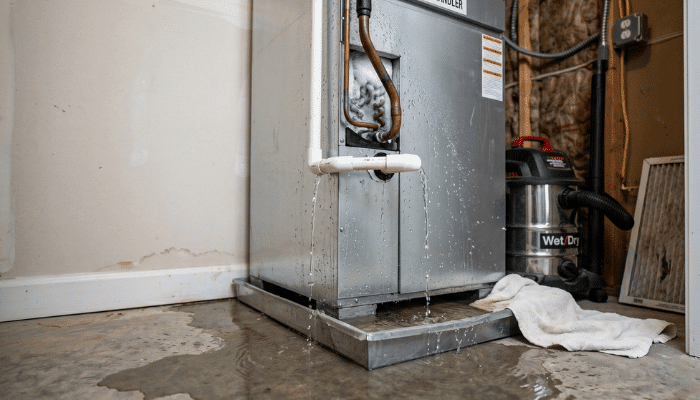
Finding water pooled beneath your indoor air handler — or dripping from the ceiling near a vent — is unsettling. It's also one of the more common calls we get during Triangle summers. The good news: the most frequent cause is something straightforward. The bad news: leaving it alone long enough will damage drywall, subfloor, and potentially introduce mold into your system.
Here's what's causing it and what to do.
How Your AC Produces Water in the First Place
This surprises a lot of homeowners: your AC produces water as a normal part of cooling. When warm, humid air passes over the cold evaporator coil inside your air handler, moisture condenses on the coil surface — the same way a cold glass sweats in summer. That water drips into a drain pan beneath the coil and exits your home through a condensate drain line, usually routed to a floor drain, utility sink, or outside.
On a hot, humid North Carolina day, a properly functioning AC can remove several gallons of water per hour from your home's air. That's a lot of water moving through a relatively simple drainage path — and several things can interrupt it.
Cause #1: Clogged Condensate Drain Line (Most Common)
The condensate drain line is typically a 3/4" PVC pipe. Over time, algae, mold, and mineral deposits build up inside and restrict — or completely block — water flow. When that happens, water backs up into the drain pan, overflows, and finds the path of least resistance through your ceiling or onto your floor.
Signs this is the cause: Water dripping near the air handler, often with no other symptoms. The system may still be cooling normally.
What to do: Some homeowners clear minor clogs using a wet/dry vacuum at the outdoor drain line termination. Pouring a diluted bleach solution down the access port monthly during the cooling season helps prevent buildup. If the line is fully blocked or you're already seeing water damage, have a technician clear it properly and inspect the drain pan.
Condensate drain clearing is one of the standard tasks included in our annual AC maintenance visits — it's routine preventive work that our summer maintenance guide also covers in detail.
Cause #2: Frozen Evaporator Coil
If the evaporator coil freezes over and then thaws, the resulting meltwater can overwhelm the drain pan. A frozen coil produces more water at once than the drainage system is designed to handle.
Signs this is the cause: The system runs but isn't cooling effectively, ice may be visible on the refrigerant lines coming off the air handler, and water appears when the ice melts — often after you turn the system off.
What causes the coil to freeze:
- A dirty air filter restricting airflow — the most common trigger
- Low refrigerant, which drops coil temperature below freezing
- A failing blower motor not moving enough air across the coil
- Blocked or closed supply vents
What to do: Switch the system to "fan only" or turn it off entirely to let the coil thaw — running it while frozen makes things worse. Replace your air filter. If the freezing recurs after the filter change, you likely have a refrigerant or airflow issue that needs a professional diagnosis.
Cause #3: Improper Insulation on Refrigerant Lines
If refrigerant lines aren't properly insulated, condensation forms on the outside of the lines and drips. This can be mistaken for an active leak from the unit itself.
Signs this is the cause: Moisture appears along the refrigerant lines rather than from the air handler, and the drain system appears functional.
Cause #4: Disconnected Drain Line
Drain line connections occasionally come loose from vibration over time, or following a maintenance visit where the line wasn't properly resecured. A disconnected line empties directly into whatever space the air handler sits in — utility closet, attic, or crawl space.
Signs this is the cause: Significant water accumulation near the air handler, appearing relatively quickly after the system runs.
Mold Risk: Why You Don't Want to Leave This Alone
The EPA's guidance on mold and moisture is clear: mold can begin growing on wet building materials within 24 to 48 hours. A backed-up condensate drain that causes repeated wetting of drywall, insulation, or subflooring creates exactly the conditions mold needs. If your system has been leaking for more than a couple of days, it's worth having the water damage assessed — and it may be worth scheduling a system sanitizing service through our indoor air quality team to address any biological growth on the coil or drain pan surface.
The Humidity Factor: Why This Is More Common in North Carolina
The Triangle's summer humidity makes this problem more acute than it would be in drier climates. More humidity in the air means more condensate produced. A drain line that handles the load fine in spring can back up in July when the system is pulling significantly more moisture out of the air. If you've been in your home for years without a condensate issue and one suddenly develops, the system didn't change — the seasonal demand on it did.
What to Do Right Now If Your AC Is Leaking
- Turn the system off if water is actively pooling — running it while the drain is backed up worsens the situation and risks water damage.
- Check and replace your air filter. A clogged filter is a surprisingly common contributor to AC water issues.
- Look for ice on the refrigerant lines. If you see it, you have a frozen coil situation. Let it thaw before doing anything else.
- Check the condensate drain termination point (usually outside at the foundation or in a utility drain) — no flow when the system runs means a likely clog.
- Call for service if the above steps don't resolve it, or if you're already seeing water damage. Water damage from a neglected drain issue compounds quickly.
Dawson's Electric & Air handles AC repair and AC maintenance throughout Fuquay-Varina, Raleigh, Cary, Apex, Holly Springs, and the Triangle. Call 919-887-8284 or schedule online. Our Peace of Mind Comfort Club includes condensate drain inspection and flushing on every annual visit — the kind of routine work that prevents a minor clog from becoming a ceiling repair.