

If you live around here, you already know the drill. We get summers that feel like a sauna, the legendary spring “Pollening,” and those strange January days that start at 70 degrees and end near freezing. Our homes range from historic Inside-the-Beltline bungalows to brand-new builds out in Wake Forest, and a lot of them share one frustration: a room or two that the central system just can’t seem to handle.
That bonus room that bakes every July. The primary bedroom that runs five degrees colder than everywhere else. If that sounds familiar, you’ve probably come across the term ductless mini split. This guide walks through what these systems actually are, how they work, and whether one makes sense for your home, so you can decide with clear information instead of a sales pitch.
Your ductless mini split guide
This page is the starting point. Once you understand the basics below, these companion articles go deeper on the questions homeowners ask us most:
What is a ductless mini split?
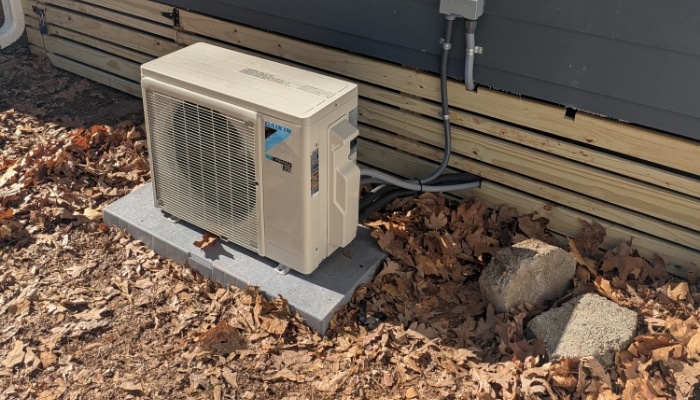
Think of a mini split as a cross between central air conditioning and a window unit, with the power of the former and the flexibility of the latter. Where central air pushes conditioned air through a network of ducts, a ductless system delivers comfort straight to the room it’s in.
Every system has two main parts:
- An outdoor compressor that sits beside your home, similar to a traditional AC condenser.
- One or more indoor air handlers, the slim units mounted on a wall or ceiling inside the room.
A small refrigerant line runs between the two through a hole about three inches wide. That’s the whole footprint. No bulky ductwork, no major demolition.
How do ductless mini splits work?
The easiest way to understand why these systems run so efficiently is to look at what they don’t do. They skip the ductwork, so almost nothing is lost between the unit and your living space. Most mini splits are high-efficiency heat pumps that move heat rather than make it, and they use a variable-speed inverter compressor that adjusts to hold a steady temperature instead of slamming on and off. Here’s each piece in plain terms.
They skip the ductwork, so they skip the waste
According to the U.S. Department of Energy, duct losses can account for more than 30% of a home’s energy use for space conditioning, especially when ducts run through an attic or crawlspace. A mini split moves heat through refrigerant lines instead of blowing air through ducts, so there’s almost nothing lost between the unit and your living space.
They move heat instead of making it
Most mini splits are high-efficiency heat pumps. In summer they pull heat out of the room and send it outside. In winter they run in reverse, drawing warmth out of the outdoor air (yes, even on a cold morning) and bringing it inside. It’s the same principle as a refrigerator, just pointed where you want it.
They adjust instead of slamming on and off
A standard HVAC system is essentially all-on or all-off, which is what causes those temperature swings you feel through the day. Mini splits use a variable-speed (inverter) compressor that speeds up and slows down to hold a steady temperature, a lot like cruise control in your car. That steadier operation is a big part of why they sip energy rather than gulp it.
Why mini splits fit Raleigh-area homes so well
Our region throws a specific mix of challenges at a heating and cooling system, and ductless setups happen to answer most of them.
Older homes stay intact
If you’re in a historic home around Oakwood or Five Points, the last thing you want is to tear into original plaster or crown molding to make room for ducts. A mini split needs only that small three-inch line set, so the character of the house stays where it belongs.
They handle our humidity
North Carolina humidity is no joke, and mini splits are excellent dehumidifiers. Because they run in longer, lower-power cycles, they have more time to pull moisture out of the air. The result is a home that feels crisp instead of clammy.
You only condition the rooms you’re using
There’s little sense in cooling a guest room and kitchen at 2 a.m. With a multi-zone system, you set each room on its own, or switch off the ones nobody’s in. Over a long Triangle summer, that zoned control shows up directly on your Duke Energy bill.
How the options stack up
Around here we deal with high humidity and “shoulder seasons” where you want a little heat in the morning and cooling by mid-afternoon. Here’s how the three most common comfort options compare. If you want to dig into the trade-offs for your specific home, our guide on which HVAC system is best for your home goes further.
| Feature | Window / Portable Unit | Central HVAC (Ducted) | Ductless Mini Split |
|---|---|---|---|
| Energy efficiency | Low (8–10 SEER2) | Mid (14–17 SEER2) | High (20–30+ SEER2) |
| Noise level | Loud fan and thumping | Moderate (air rushing) | Whisper quiet |
| Security | Low (open window) | High | High (3″ wall hole only) |
| Humidity control | Poor | Average | Excellent (dry mode) |
| Zoning control | Single room only | Whole house (all or none) | Room-by-room precision |
| Installation | DIY, temporary | Intensive (ductwork) | Professional, minimal impact |
Is a mini split worth the investment?
The upfront cost of a ductless system is usually higher than a window unit, so the real question is what you get back over time. Homeowners switching from baseboard heat or window units often see a meaningful drop in heating and cooling costs, income-eligible households may qualify for rebates through Energy Saver NC and Duke Energy, and adding permanent climate control to a garage, sunroom, or attic adds usable square footage a window unit never could. A few things tend to tip the math in its favor:
Lower utility bills
Homeowners switching from baseboard heat or window units often see a meaningful drop in heating and cooling costs, thanks to the efficiency and zoning we covered above.
Rebates and incentives
This is where it pays to check current programs, because the numbers and eligibility rules change often. As of this writing, two are worth knowing about:
- Energy Saver NC (HEAR program). For income-eligible households, this state program offers up to $8,000 toward a qualifying ENERGY STAR heat pump. Eligibility is based on your household income relative to the area median, so the amount you qualify for depends on your situation. You can check current details and eligibility on the official Energy Saver NC site.
- Duke Energy HVAC rebates. Duke offers rebates of up to $1,000 on qualifying heating and cooling upgrades. These are generally geared toward ducted central heat pump and AC replacements rather than ductless equipment, so it’s worth confirming which of your options qualify before you decide.
Rebate amounts, eligibility, and program availability change frequently. The links above go to the official program pages so you can confirm what’s current. We’re also happy to tell you exactly what your project qualifies for.
Added home value
Putting quiet, permanent climate control into a garage, sunroom, or finished attic effectively adds usable square footage, something a window unit can never do. If a garage is your project, our piece on installing a mini split in your garage covers what to expect.
Ready to talk specifics?
Once you’ve got the basics down, the next step is sizing a system to your actual rooms. Our ductless mini split service page walks through what installation looks like with Dawson’s, or you can jump straight to what’s involved in the installation.
Stop fighting your thermostat. Start zoning your comfort.
Is there one room in your home that just won’t cooperate, no matter how low you set the AC? You don’t have to overhaul your whole system or open up your walls to fix it. At Dawson’s Air, we specialize in the “impossible” spaces, whether that’s finishing a garage in Fuquay-Varina or finally making that North Hills sunroom usable. We’ll help you design a ductless system that earns its keep in comfort and energy savings.
Call 919-887-8284 to schedule your custom comfort consultation, or contact us online with any questions. Ask us about the current Duke Energy and Energy Saver NC rebates and our financing options.