

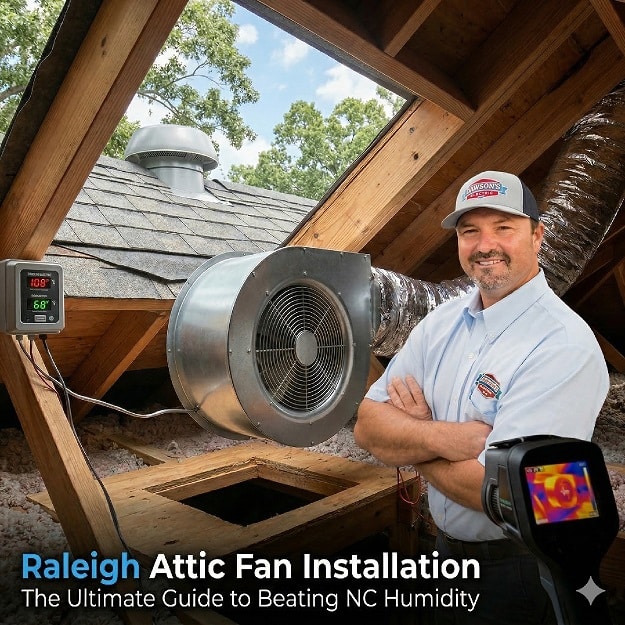
Beyond Simple Ceiling Fan Installation in Raleigh Home's
In Raleigh, an attic fan isn't just a "set it and forget it" appliance; it is a mechanical component of your home's respiratory system. With our local humidity averaging 70% in July, a poorly planned installation can actually pull humid air into your home rather than just pushing heat out.
1. The "Raleigh Pressure Trap": Why CFM Matters More Than Horsepower
Most electrical contractors install a fan based on square footage alone. However, Raleigh’s many 1970s–90s homes (especially in neighborhoods like North Hills or Cary) have "leaky" ceiling planes.
The Solution: You must ensure your Intake-to-Exhaust ratio is balanced.
If your attic fan (Exhaust) pulls more air than your soffit vents (Intake) can provide, it creates negative pressure. This "traps" the home, sucking conditioned (expensive) air from your living room through recessed lights and top plates into the attic.
-
Unique Proof Block: The 1:300 Rule for the Triangle. For every 300 sq. ft. of attic floor, you need 1 sq. ft. of Net Free Ventilating Area (NFVA). In Raleigh’s "Zone 4" climate, we recommend a 1:150 ratio to account for high vapor pressure.
-
Local Insight: If you have a crawl space, a powerful attic fan can actually pull musty crawl space air up through your wall cavities. Always pair a fan installation with top-plate air sealing.
2. Humidity vs. Heat: The Humidistat Essential
Most "off-the-shelf" fans at big-box stores in Wake County only have thermostats. They turn off when it’s cool. But in Raleigh, some of our most damaging attic moisture occurs on 70-degree rainy days when the humidity is 95%.
The Solution: Dual-Control Sensors
Your installation must include both a thermostat (set to 105°F) and a humidistat (set to 65% RH).
-
Protecting your roof decking from "stealth mold." Raleigh’s spring "pollen season" often clogs soffit screens; a humidistat ensures the fan clears moisture even when the temperature doesn't trigger a standard fan.
-
Do not accept a quote for a fan that lacks an adjustable humidistat. In the Triangle region, heat kills shingles, but humidity kills rafters.
3. Solar vs. Electric: The "Triangle Shade" Factor
Solar fans are popular for "green" homeowners, but Raleigh’s lush tree canopy often renders them useless by 3:00 PM—exactly when the attic hit its peak thermal mass.
The Solution: Hybrid Power Systems
A standard 20W solar fan moves ~800 CFM. A Raleigh attic in August needs ~1,500–2,000 CFM to actually drop the temperature.
-
Pro Tip: If your lot has heavy oak or maple shading, an electric-powered fan is non-negotiable for performance. If you have clear southern exposure, a solar fan with a battery backup or AC-bypass is the only way to ensure evening cooling.
4. Local Pricing & "The Duke Energy Factor"
The Problem: Ghost quotes. Many Raleigh sites list "starting at" prices that don't include the necessary electrical circuit or roof flashing.
The Solution: All-In Pricing Transparency
| Component | Estimated Cost | Why it fluctuates |
| Mid-Grade Power Fan | $350 – $600 | Brand (QuietCool vs. Master Flow) |
| Electrical Labor | $250 – $450 | Distance to the panel; NC Code requirements |
| Roofing/Flashing | $200 – $400 | Shingle type (Architectural vs. 3-Tab) |
| Total Professional Install | $800 – $1,450 |
While rebates often focus on insulation (R-38 to R-60 upgrades), professional ventilation is a prerequisite for these incentives to be effective.
Attic Fan FAQs
Yes, but only if your attic floor is air-sealed. In Raleigh, we see "short-circuiting" where fans pull cold air from the house. A proper install includes a smoke-pencil test to ensure the fan is pulling from the outdoors, not your hallway.
Often, yes. Raleigh’s "low-wind" summer days mean ridge vents (which rely on the Bernoulli effect) fail to move air. A powered fan provides "active" rather than "passive" protection.
March or October. Avoid July—not just for the heat, but because Raleigh roofing crews are at peak demand, and you'll pay a "heat premium" for labor.
Take the "Raleigh Attic Stress Test" Tonight
Don’t guess if your ventilation is failing—test it yourself for free.
Tonight, after the sun goes down but while the air is still humid, head to your attic hatch. Gently crack it open just two inches and hold a single ply of toilet paper or a thin incense stick near the gap.
-
If the paper/smoke gets sucked into the attic: Your home has a "pressure leak." Your current ventilation is literally stealing the expensive A/C you just paid Duke Energy for.
-
If it stays still: You’re likely "air-locked," and your shingles are "baking" from the inside out.
Stop the invisible pull on your wallet.
We don't just "install ceiling fans"—we calibrate your home's breathing. Mention the "Raleigh Stress Test" when you book, and we’ll include a free thermal-leak check of your recessed lights and top plates during our visit.