

If you are researching how to upgrade an electrical panel without rewiring, you are likely weighing cost, downtime, and safety. The good news is that in many homes, a panel upgrade or replacement can happen without a full rewire. Below we explain when that is safe, when code requires more work, what it costs in the Raleigh area, and how Dawson's Electric manages permits, inspections, and utility coordination to make it stress‑free.
The Short Answer: Yes, Sometimes You Can Upgrade Without Rewiring
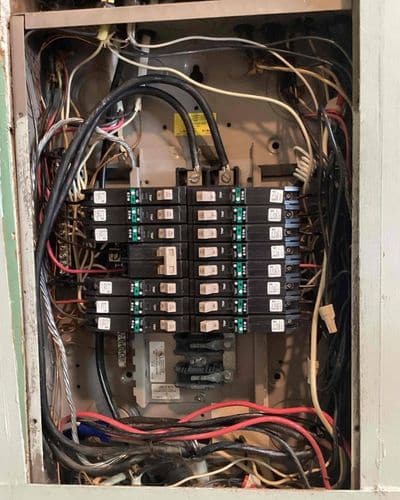
In many homes, you can replace or upgrade the electrical panel without rewiring the entire house. Whether that is safe and compliant depends on the condition of your existing wiring, the service size you need, and local code. For example, replacing a failing panel with a like‑for‑like amperage often needs no whole‑home rewire. Increasing capacity, like 100 amps to 200 amps, may still avoid a rewire if the branch circuits test healthy and meet code.
What we check first:
- Wire condition and type on each circuit.
- Proper grounding and bonding at the service.
- Breaker compatibility and labeling.
- GFCI and AFCI protection where required.
- Load calculation to size service correctly.
Panel Replacement vs. Panel Upgrade vs. Service Upgrade
It helps to separate three similar terms so you know what to expect.
Panel replacement
- Swap the existing panel for a new panel of the same amperage.
- Usually no whole‑home rewire if wiring is safe and code compliant.
- Ideal when the current service size is adequate but the panel is outdated, damaged, or recalled.
Panel upgrade
- Increase the panel's amperage to add capacity and more circuit spaces.
- Common jump is 100 amps to 200 amps. Most modern homes need 200 amps.
- Can be done without a rewire if existing branch circuits and grounding pass inspection.
Full service upgrade
- Includes new panel, meter, and service equipment, and utility coordination.
- Needed when increasing amperage or relocating service equipment.
- Often still does not require a whole‑home rewire if wiring condition is good.
When You Do Not Need New Wiring
You likely avoid a rewire if the following are true:
- Branch circuit wiring is copper or safe aluminum remediation is in place.
- Insulation on conductors is intact with no heat damage.
- Grounding electrode system and bonding are correct.
- Breaker sizes match conductor sizes, and neutrals/grounds are terminated properly.
- Required GFCI and AFCI protection can be provided by new breakers or devices.
Common situations where customers skip rewiring:
- Like‑for‑like panel replacement due to age, corrosion, or obsolete brands.
- Adding a subpanel to gain more circuit space while keeping existing circuits.
- Installing a 40–50 amp dedicated circuit for an EV charger when the main panel still has safe, available capacity.
When Code or Safety Triggers More Than a Panel Swap
Sometimes the panel is only part of the story. You may need circuit work or targeted rewiring if we find:
- Overheated or brittle insulation on older conductors.
- Aluminum branch circuits without proper AlumiConn or CO/ALR remediation.
- Ungrounded circuits where GFCI requirements cannot be met at devices.
- Double‑tapped breakers, oversized breakers, or mixed neutrals on shared terminals.
- Knob‑and‑tube wiring or hazardous DIY splices.
If any of the above appear, we outline options:
- Targeted repairs on the affected circuits.
- AlumiConn or CO/ALR retrofitting for 1960s–70s aluminum wiring.
- Dedicated circuits for high‑demand appliances, HVAC, or EV charging.
- Full or partial rewiring if hazards are widespread.
What a Professional Panel Upgrade Includes
A quality upgrade is more than swapping a box.
- Load calculation to size the service at 100–400 amps based on your real usage.
- Permit pulled and inspection scheduled. We handle the paperwork.
- Utility coordination for service disconnect and reconnection when needed.
- New panel with properly labeled circuits and torque‑verified terminations.
- Whole‑home surge protector offered at the panel to protect every circuit.
- AFCI and GFCI protection tested and documented.
- Clean, careful retrofit that respects finishes. We are experienced with historic plaster.
Do You Need 200 Amps?
Many homeowners ask if 200 amps is the new standard. For most modern homes, yes. However, small homes with modest loads may be fine at 100–150 amps. Large homes with electric heat, EVs, or workshops can need 300–400 amps.
We recommend a precise load calculation. Factors that push you toward more capacity:
- Heat pump or electric furnace additions.
- EV charging on a dedicated 40–50 amp circuit.
- Hot tub, sauna, or pool equipment.
- Home office with dedicated circuits and backup power needs.
The good news: these high‑demand circuits can usually be added during your panel upgrade, sized to code, without touching the rest of your home's wiring.
Add‑Ons That Protect Your Investment
If you are touching the panel, it is the right time to add safety and resilience.
- Whole‑home surge protection to guard every circuit from voltage spikes.
- Smart panel options for real‑time energy monitoring and load control.
- Transfer switch, manual or automatic, for safe generator integration.
- Weather‑resistant, commercial‑grade GFCIs in damp or outdoor locations.
- Subpanel for future expansion without crowding the main panel.
These upgrades reduce nuisance trips, improve safety, and prepare you for storms and EV adoption.
What to Expect: Cost, Timeline, and Permits
In the Raleigh area, a typical upgrade from 100 amps to 200 amps runs $1,200 – $4,500 for most homes. You will receive an upfront, flat price after our evaluation, so you know exactly what to expect.
Your price depends on:
- Whether service conductors and meter base need replacement.
- Panel location and working clearances.
- Need for a mast, weather head, or service relocation.
- Adding surge protection, transfer switch, or a subpanel.
- Remediation of aluminum wiring or damaged conductors if discovered.
- On timeline and downtime: most panel replacements and 100‑to‑200 amp upgrades take one to two days, with power off for several hours during the cutover. Panel and service upgrades require permits in our area — we handle all permitting and inspections and coordinate with the utility when a disconnect is needed, so you do not spend time on paperwork or phone trees. Your project is backed by a three‑year parts and labor warranty on covered services. As an Eaton Certified Contractor and Tesla Certified installer, we follow manufacturer guidance for equipment and terminations.
Historic Homes and Clean Retrofits
Older homes need finesse. We specialize in upgrades that protect original plaster and finishes while modernizing the system. When walls must be opened, we plan small, strategic access points and clean up thoroughly. For 1960s–70s homes with aluminum wiring, we offer AlumiConn or CO/ALR retrofitting that is safer and far more cost‑effective than a full rewire when conditions allow.
Yes, if existing branch circuits are in good condition and meet code. We inspect wiring, grounding, and protection. If everything checks out, a panel‑only replacement or upgrade is often safe and compliant.
Most modern homes benefit from 200 amps, especially with EVs, heat pumps, or hot tubs. Small homes may be fine with less, and large all‑electric homes may need 300–400 amps. A load calculation gives the right answer.
Most panel replacements and 100‑to‑200 amp upgrades take one to two days. Power is typically off for several hours during cutover. We coordinate permits, inspections, and the utility to reduce downtime.
If you increase service size or relocate the service, yes. We handle utility coordination, permits, and inspections so the changeover is smooth and compliant.
Homes from the 1960s–70s often have aluminum branch circuits. We offer AlumiConn or CO/ALR retrofitting, a safer and more cost‑effective option than a full rewire when conditions allow.
The Bottom Line
You can often upgrade an electrical panel without rewiring when your existing circuits are safe and code compliant. In the Raleigh area, most 100‑to‑200 amp upgrades take one to two days and cost about $2,000 to $4,000. For a clear answer and an upfront price, schedule your load calculation with Dawson's Electric & Air today.
Ready to Get Started?
Call 919-887-8284 or schedule online to book your evaluation. Serving Raleigh, Durham, Cary, Apex, Fuquay Varina, and nearby Triangle communities.