

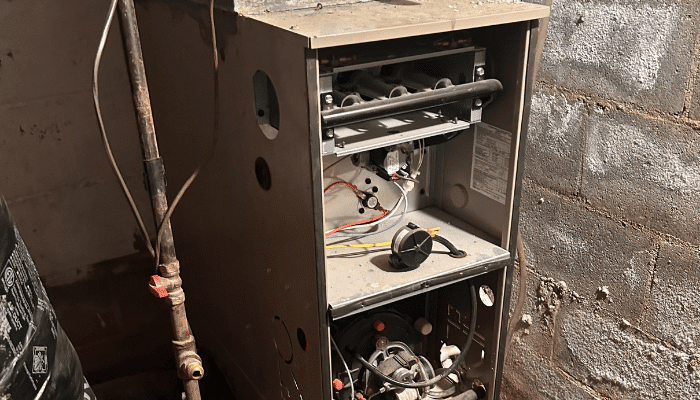
Try These Simple Fixes Before Calling a HVAC Pro in the Triangle
You wake up in your Raleigh home on a freezing morning, expecting a warm house. Instead, you feel a harsh, chilly breeze blasting right out of your bedroom vents. A heating system blowing cold air creates immediate panic for any homeowner.
Before you assume the entire unit is broken, you can often fix the issue yourself.
Dawson’s handles this exact complaint constantly across Durham, Wake, and Harnett counties every winter. Sometimes the fix requires a simple button press on your wall. Other times, the cold air means a hidden safety mechanism just shut your system down to prevent a fire.
The Quick Fixes You Can Do Right Now
Let’s explore the most common reasons your vents feel like an open window.
Should My Thermostat Fan Be on AUTO or ON?
Start by looking directly at your thermostat screen.
- If the fan setting reads “ON,” your system blows air non-stop, even when the heating burners sit idle. Moving unheated air around the house feels drafty, tricking you into thinking the system failed.
- Switch the setting to “AUTO” so the fan only runs during an active heating cycle.
Since Dawson’s handles both electrical and HVAC work, we frequently uncover a hidden issue with modern smart thermostats. If your smart thermostat lacks a dedicated C-wire (common wire), it might pulse your HVAC fan just to steal power for its own internal battery.
This electrical shortcut forces your air handlers to push unheated air randomly throughout the day. Upgrading your thermostat wiring permanently stops this frustrating phantom draft.
Does a Dirty Air Filter Cause a Furnace to Blow Cold Air?
Yes, and this specific issue causes most of the winter service calls we run.
Homeowners often buy the most expensive, hospital-grade filters available at the local hardware store. High MERV ratings trap microscopic dust, but they also severely choke the airflow moving into your equipment.
Here in the Triangle, heavy spring pine pollen and dusty fall harvest seasons pack these thick filters full of debris incredibly fast. When your furnace cannot pull in enough fresh air, the internal heat exchanger gets dangerously hot.
This intense heat triggers an internal safety device called the high-limit switch. Once the high-limit switch trips, it instantly kills the burners to prevent a house fire. The blower fan stays on intentionally to cool down the overheated metal components. You feel this safety measure as cold air blasting from your vents.
Swap that restrictive filter for a basic fiberglass one, reset your system, and the warm air usually returns.
Mechanical Failures Inside Your Heating System
When simple thermostat tweaks and filter swaps fail to restore the heat, an internal component has likely shut down for safety. These mechanical and electrical glitches require a closer look at what is happening inside the unit itself.
How Do I Know if My Flame Sensor is Bad?
Your system uses a tiny metal rod called a flame sensor to prove a fire actually ignited. Over years of use, microscopic carbon soot and dust bake onto this rod. If the sensor gets completely coated in grime, it cannot feel the heat from your electronic ignition or pilot light.
When the sensor fails to detect a flame, it assumes raw gas is flooding your basement unlit. It immediately shuts the gas valve down to keep your family safe. Just like the overheated filter scenario, the blower fan continues running to clear out any leftover gas fumes.
Wait, Do You Actually Have a Heat Pump?
Many North Carolina residents refer to any heating unit as a furnace. In reality, heat pumps dominate the Raleigh and Durham housing markets. Heat pumps extract heat from the outside air, which completely changes how the system feels indoors.
Why is My Heat Pump Blowing Cold Air in Winter?
A gas flame produces supply air that reaches 130 degrees, feeling intensely hot to the touch. A heat pump produces air closer to 90 degrees. Because normal human skin sits at 98 degrees, that 90-degree heat pump air actually feels cool when it blows across your face.
Heat pumps also periodically run a heat pump defrost cycle to melt ice off the outdoor compressor during freezing rain. To melt the ice, the system briefly shifts into air conditioning mode. It will blow cold air inside for roughly ten minutes, melt the outdoor ice, and automatically switch back to standard heating.
When to Call the Pros at Dawson’s
If you already adjusted your thermostat settings and replaced a dirty filter, the problem requires an HVAC contractor.
Digging into your heating and cooling system without proper training exposes you to high-voltage electricity and live gas lines. A licensed HVAC technician can safely clean a dirty flame sensor or replace a faulty high-limit switch.
Dawson’s offers NATE certified technicians.
Ready for Help?
Scheduling routine HVAC preventative maintenance stops these freezing mornings before winter even arrives. Our technicians verify gas pressure, scrub the sensors, and ensure your electrical controls communicate with the mechanical parts perfectly.
If you are tired of wearing a heavy winter coat inside your own living room, reach out to Dawson’s today by calling 919-887-8284 to schedule your HVAC service or contact us online with any questions.
Dawson’s is proud to serve homeowners across Raleigh, Durham, Chapel Hill, Garner, Cary, Fuquay-Varina, and throughout Wake and Harnett counties.
Wherever you call home in the area, you can count on our dedicated team for dependable, certified professional service tailored to your needs.