

A Homeowner's Guide to Electrical Panels in the Raleigh Area
If you’ve ever had an electrician mention brand names like Square D, Siemens, Eaton, GE, or Federal Pacific, you’re not alone in nodding along without knowing what they all mean. Most homeowners aren’t expected to understand the differences between electrical panel brands, but those differences can play a significant role in the safety and performance of your home.
When it comes to electrical panels, the brand, age, and build quality matter more than many people realize. Some panels are known for reliability, strong safety records, and long-term availability of parts, while others have been associated with recalls, performance issues, or outdated designs that no longer meet modern electrical demands. This becomes especially important in older Raleigh-area homes, where original panels may still be in service decades later.
At Dawson’s Electric & Air, we believe an informed homeowner is a safer homeowner. This guide breaks down the most common electrical panel brands found in our service area, what to know about each, and how to better understand the condition and safety of your home’s electrical system.
Electrical Panels
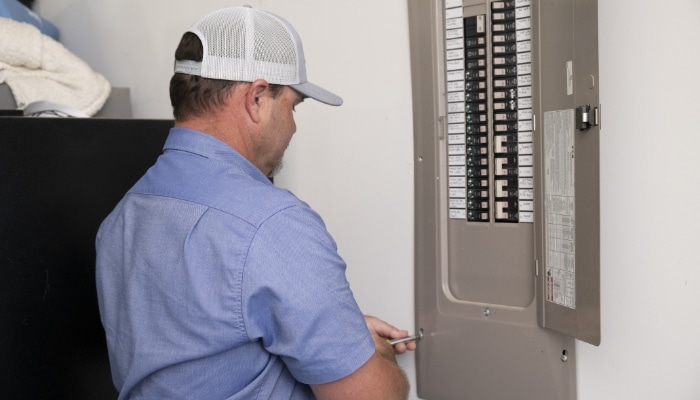
The electrical panel, also called a breaker box or load center, is the heart of your home's electrical system. It receives power from the utility company and distributes it through circuits to every room. When something goes wrong electrically, the panel's breakers are designed to trip and stop the flow of power before overheating and short circuits occur to prevent fires and property damage. The keyword there is designed.
Not all panels live up to that promise. Here are the six brands you're most likely to encounter in Raleigh-area homes, old and new alike.
1. Square D (Schneider Electric)
Widely Recommended by Electricians
Square D is consistently ranked as one of the most trusted panel brands in the U.S., and for good reason. Now owned by Schneider Electric, Square D panels are known for their durability, broad availability of replacement breakers, and strong safety certifications. Their Homeline and QO (Qwik-Open) series are found in hundreds of thousands of Triangle-area homes.
Square D Homeline panels are built with tin-plated aluminum bus bars rather than copper. While Square D’s higher-end QO line typically uses copper bus bars, the Homeline series is designed as a more budget-friendly option for residential applications and does not offer a copper bus bar version. At Dawson’s Electric & Air, we strongly recommend choosing panels with copper bus bars whenever possible.
Pros:
- Exceptional reliability and industry longevity
- Replacement breakers are widely available, even for older panels
- QO breakers feature a visual trip indicator flag for easy diagnosis and troubleshooting
- Widely supported and trusted by licensed electricians across the Raleigh area
Cons:
- QO-series breakers can run slightly more expensive than competitors
- Certain models were subject to a recent manufacturer recall
Schneider Electric has recalled more than 1.4 million Square D electrical panels manufactured between February 2020 and January 2022 due to a potential fire and burn hazard. This issue involves a possible loose neutral connection, which can lead to overheating.
If your Square D panel has a date code of 200561 to 220223, it’s a good idea to have it inspected by a licensed electrician.
2. Siemens — The Modern Workhorse
Highly Reliable | Popular in Raleigh Construction
Siemens is another top-tier choice and has become a go-to for many new construction projects across Cary, Wake Forest, Fuquay-Varina, and North Raleigh. Their panels are known for solid build quality, dependable performance, and broad breaker availability, making them a practical and reliable choice for many homes.
Siemens also comes available with copper or aluminum bus bars. In most new construction, aluminum bus bars are commonly used due to their lower cost. However, for panel upgrades and replacements, Dawson’s Electric & Air prioritizes Siemens models with all-copper bus bars.
Due to fewer supply issues and their overall availability, Siemens copper bus models have become our preferred choice for electrical panel upgrades and replacements.
Pros:
- High build quality with consistent breaker performance
- Widely used in new construction and upgrades throughout Raleigh and surrounding areas
- Offers advanced arc-fault and ground-fault protection options
- Strong reliability and consistent performance
Cons:
- Some electricians note that Siemens breakers are slightly less 'snappy' in feel than QO-series breakers
- Copper bus models are typically more expensive
Recall Status: No major residential panel recalls. Siemens has maintained a strong safety profile in the residential market.
3. Eaton (Cutler-Hammer) — Reliable but Complicated History
Generally Reliable | Watch for Challenger-branded Products
Eaton residential panels, often associated with the Cutler-Hammer name, are generally considered a solid and reliable option for copper bus panels in both new installations and upgrades. Eaton’s BR series offers other cost effective models that use aluminum bus bars. The BR series is commonly used in new construction and is frequently found in big-box stores.
Eaton’s history includes the acquisition of several legacy brands, including Westinghouse/Challenger and Bryant brands. Bryant panels were commonly installed in homes across the Raleigh area from the 1960’s through the 1980’s, while Westinghouse was another popular brand installed in mid-20th century homes.
Dawson’s Electric & Air is an Eaton-certified contractor, and we consider Eaton’s Cutler-Hammer copper bus models to be among the top-rated panel options available. However, due to ongoing supply challenges with certain Eaton components, we have been installing fewer of these in recent years.
Pros:
- Strong modern panel performance and safety ratings
- Widely available, often found at Lowe's across the Raleigh area
- Good arc-fault and GFCI breaker integration
Cons:
- Eaton acquired the Challenger brand — some Challenger panels continued to be produced with quality issues after the acquisition
- Breaker availability is occasionally more limited than Square D or Siemens
- Certain panels and breakers have been very difficult to get and they have experienced many supply issues in recent years.
⚠ RECALL ALERT: Challenger panels (now associated with Eaton/Cutler-Hammer) were recalled in 1988 for 15- and 20-amp circuit breakers made between February and April of that year. A mechanical component could detach, causing overheating, melting, and fire. Additionally, Eaton/Cutler-Hammer recalled approximately 1,000 panels in 2014 because easily accessed components presented a shock risk. If your home was built between 1980 and 1995, have a licensed electrician inspect any Challenger-branded panel.
4. General Electric (GE)
Widely Installed | Builder-Grade Legacy Panels
General Electric (GE) has been a major player in electrical manufacturing for over 70+ years, producing everything from residential breakers to large-scale industrial switchgear. GE became a household name in electrical distribution throughout the mid to late 20th century, and its residential breaker lines, such as the THQL series, were widely adopted due to their availability and affordability.
Over time, GE’s electrical division transitioned, and today its distribution equipment is largely associated with ABB (Asea Brown Boveri). For homeowners, GE panels were commonly installed as a builder-grade standard in production homes across Raleigh, Cary, Fuquay-Varina, and the surrounding Triangle area.
Pros:
- Widely installed and recognized
- More affordable and budget-friendly than competitors
- Widely available at supply houses and big-box stores
- Proven track record of reliability
Cons:
- Strong modern panel performance and safety ratings
- Many GE panels utilize aluminum bus bars instead of copper
Although GE panels are common and widely used across the Triangle, not all electrical panels share the same level of safety and reliability. Some older panel brands have known design flaws and recall histories that can present serious hazards if still in service.
5. Federal Pacific Electric (FPE) — A Known Fire Hazard
AVOID | Legacy Equipment Only | Replacement Strongly Recommended
If your home was built between 1950 and 1990, there is a real chance it could have a Federal Pacific Electric (FPE) Stab-Lok panel. These panels were among the most installed in America during that era, and they are widely considered among the most dangerous still in use today.
The core problem: FPE Stab-Lok breakers were found to have been certified using falsified testing data. Independent research by electrical engineer Jesse Aronstein found that roughly 1 in 4 Stab-Lok breakers fails to trip during an overload, meaning instead of cutting power, they allow circuits to overheat. Estimates suggest these panels contribute to approximately 2,800 house fires, 13 deaths, and $40 million in property damage annually.
Pros:
- None applicable in a modern safety context
Cons:
- Breakers frequently fail to trip during electrical overloads
- Breakers were certified using deceptive testing practices
- No ground wire to prevent power surges from overloading breakers
- Insurance companies frequently deny coverage or increase premiums for homes with FPE panels
- Cannot legally be installed new under current NEC requirements
⚠ RECALL STATUS: FPE Stab-Lok panels were never officially recalled, largely due to the CPSC closing its investigation in 1983 citing budget constraints, not because the panels were found safe. A New Jersey court later ruled that Federal Pacific Electric had fraudulently labeled its breakers as meeting safety standards. The company is now defunct. If your home has one of these panels, the Dawson's Electric team strongly recommends scheduling a panel inspection and replacement as soon as possible.
How to know if you have a Federal Pacific Panel in your home: Look for a panel labeled 'Federal Pacific,' 'FPE,' or 'Stab-Lok.' The breakers often have a distinctive red or orange switch face.
6. Zinsco (GTE-Sylvania) — Another Legacy Hazard
AVOID | Legacy Equipment Only | Replace Immediately
Zinsco panels were popular in the 1960s and early 1970s and share many of the same dangerous characteristics as FPE panels. The company was acquired by GTE-Sylvania in 1973, with the panels continuing under the Sylvania name before being phased out. Their primary failure: breakers that melt onto the bus bar, making them permanently unable to trip.
Pros:
- None applicable in a modern safety context
Cons:
- Breakers can fuse to the bus bar, making them impossible to trip even in overload conditions
- Aluminum wiring used internally expands under electrical current, leading to overheating
- Many insurance companies refuse to insure homes with Zinsco panels
- Non-compliant with modern NEC requirements
⚠ RECALL STATUS: Like FPE, Zinsco panels were never officially recalled despite widespread evidence of danger. The company is defunct, making repairs and replacement parts unreliable. Replacement electricians recommend completely replacing the panel, not just the breakers, as the bus bar is also compromised.
How to identify: Zinsco panels often have brightly colored (red, blue, green) breaker tabs. Look for the brand name 'Zinsco,' 'Sylvania,' or 'GTE-Sylvania' on the panel door.
How Raleigh-Area Neighborhoods Are Affected: Electrical Panels
Even if your panel is not one of the known recalled or problematic brands, older equipment can still present risks. The biggest concern is not just the name on the panel, but its age, condition, and whether it can safely handle today’s electrical demands. In the Raleigh area, the age of your home is often the strongest indicator of potential panel issues. Here’s a general guide:
- Five Points, Cameron Park, Boylan Heights, and Mordecai (1920s–1950s construction): Older homes in these historic districts may have some of the earliest residential panels, including Pushmatic panels (now considered obsolete), and early-era FPE or Zinsco installations. If you have a pre-1960 home here that has never had a panel upgrade, schedule an inspection.
- Brentwood, Longview, and Northeast Raleigh neighborhoods (1955–1985 construction): This area represents the core of Federal Pacific (FPE) and Zinsco panel installations. Homes built during this time are statistically the most likely to still contain these potentially hazardous panels. In many cases, these panels are now 30+ years old, which alone can raise concerns about reliability and safety. Signs such as heat damage, corrosion, frequent breaker tripping (or breakers that fail to trip), and panels that are full or have been modified are all indicators that an upgrade may be needed. Additionally, if you are planning to upgrade your HVAC system, install a generator, or add an EV charger, your existing panel may not have the capacity to safely support the increased electrical load. If you are buying or selling a home in these neighborhoods, a professional panel inspection is strongly recommended before closing.
- North Hills, Crabtree, and midtown Raleigh (1970s–1990s): This era saw widespread use of FPE, Zinsco, and early Challenger panels. Many homeowners in this range have already replaced their panels, but many have not. Look for home inspection reports that specifically call out panel brands.
- Cary, Apex, and Morrisville (1990s–2000s growth): Most construction from this era uses Square D or early Siemens panels. Generally lower risk, but Challenger-branded panels were still installed in some of these homes during the early 1990s.
- Wake Forest, Fuquay-Varina, Clayton, Holly Springs, and Garner (2000s–present): New construction in these booming areas almost exclusively uses modern Square D, Siemens, or Eaton panels with proper safety certifications. Much lower risk overall, though panel capacity upgrades for EV chargers and solar installations are increasingly common.
Don’t Wait for a Failure to Think About Your Panel
A lot of times, homeowners don’t think about performing routine maintenance such as tightening connections and inspecting for signs of wear and tear, steps that can help prolong the life of an electrical panel. Often, an electrician is only called when there is a complete failure, which can lead to more costly repairs or even property damage. In today’s modern homes, especially in newer communities like Wake Forest, Fuquay-Varina, Clayton, Holly Springs, and Garner, more equipment is being powered by electricity rather than gas or other fuel sources. Because of this increased demand, we recommend having a licensed electrician inspect your electrical system once a year for general maintenance.
Key things to remember, regardless of the brand installed in your home, is that electrical panels do not last forever. Even in newer construction with modern panels from brands like Square D, Siemens, or Eaton, equipment still requires proper maintenance and eventual replacement over time. Many panels begin to reach the end of their service life around the 30-year mark. If you are planning to upgrade your HVAC system, install a generator, EV charger, or add other modern electrical equipment, we strongly recommend evaluating and upgrading your panel beforehand to ensure it can safely handle the increased load.
Protecting Your Home Starts With Your Electrical Panel
Your electrical panel plays a critical role in the safety and reliability of your home, yet it’s often overlooked until something goes wrong. As we’ve covered, brand, age, condition, and proper maintenance all factor into how well a panel performs over time. Whether your home has a newer system or an older legacy panel, understanding what you have is the first step toward preventing issues before they happen.
If you’re unsure about the condition of your panel, or if you’re planning upgrades like an EV charger, generator, or HVAC replacement, having a licensed electrician perform an inspection is a smart and proactive step. At Dawson’s Electric & Air, we’re here to help you make informed decisions and keep your home powered safely and efficiently.
The safest first step is to schedule a panel inspection with a licensed electrician like Dawson's Electric & Air. We can identify the brand, age, and condition of your panel. If your home was built before 1990, pay close attention. Panels labeled 'Federal Pacific,' 'Stab-Lok,' 'FPE,' 'Zinsco,' 'Sylvania,' or 'Challenger' should be evaluated immediately. For most Raleigh-area homes, we recommend Square D, Siemens, or Eaton CH as replacement options, all three offer excellent safety records and breaker availability for years to come.